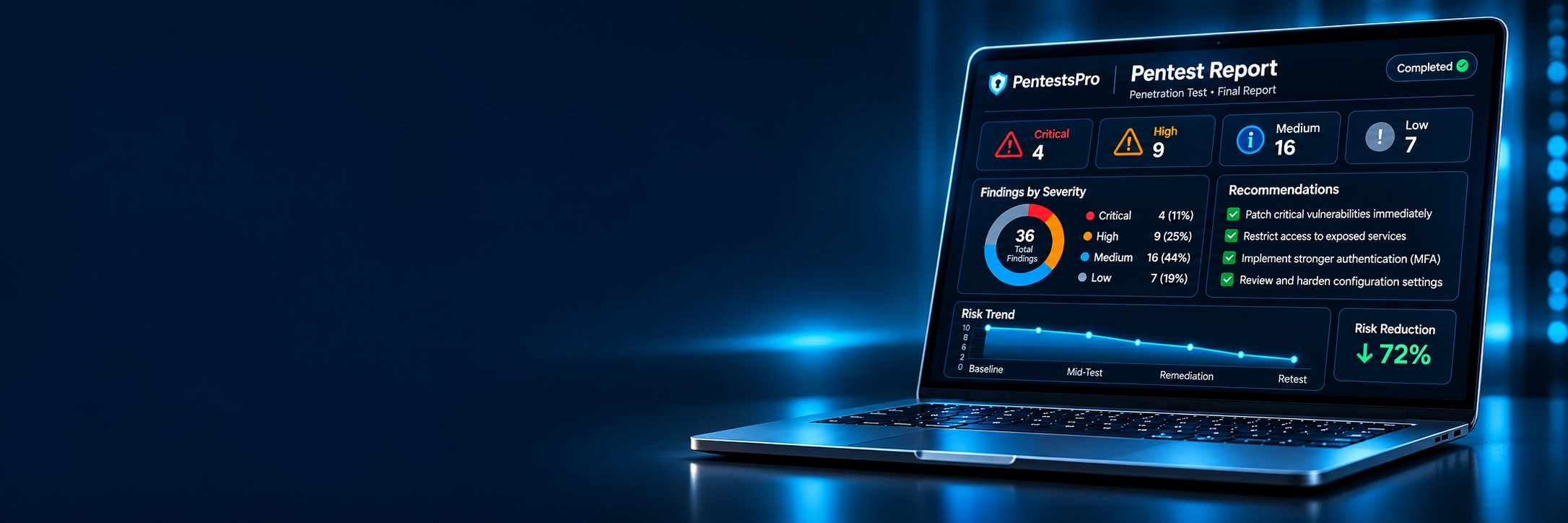
Penetration test report with findings and severity ratings
Example report

From evidence to remediation — a report built for action.

A good report does more than list problems. It shows what is really exploitable, what it means for your business and exactly what to fix first.

View pricing

Illustrative example. Everything on this page — findings, scores, components and details — is fictional and created for demonstration. It is not data from a real client or system.

At a glance

The whole picture on one page

Every report opens with a summary of confirmed findings by severity, so management sees the overall risk in seconds and engineering knows where to start.

Only verified, reproducible issues are included. No raw scanner output, no padding — just the findings that matter, ranked by real-world impact.

Sample finding

What a single finding looks like

Each confirmed issue gets the same structure: what it is, how we proved it, why it matters and how to fix it.

PP-EX-002 High · CVSS 7.5

Customer order data exposed by API endpoint (broken object-level authorization)

CVSS 3.1 vector

CVSS:3.1/AV:N/AC:L/PR:N/UI:N/S:U/C:H/I:N/A:N

Affected component

Public order-status API (/api/v2/orders/{id}) on the example store’s production environment.

Description

The endpoint returns full order details based only on a sequential order number. It does not check whether the requester owns the order, so anyone can retrieve other customers’ orders without logging in.

Proof of concept

  1. Placed a test order with a tester-controlled account and noted its order number.
  2. Requested the order-status endpoint for that number without any session — full details were returned.
  3. Requested one adjacent order number to confirm the issue affects other customers; the response was redacted in our evidence and no further records were accessed.

Business impact

Names, delivery addresses, phone numbers and purchase history of all customers could be harvested at scale. This creates a reportable personal-data breach, regulatory exposure and a direct hit to customer trust.

Remediation

  • Require authentication and verify on the server that the order belongs to the requesting customer.
  • Replace sequential order numbers in public URLs with random, non-guessable identifiers.
  • Add rate limiting and alerting for bulk requests to order endpoints.

References

OWASP API Security Top 10 (2023) — API1:2023 Broken Object Level Authorization · CWE-639

Fictional finding for illustration. Real reports include redacted screenshots and request/response evidence, shared only with authorized recipients.

Report structure

One document for management and engineering

Each part answers a different question — so every reader finds what they need without wading through the rest.

1. Executive summary

Overall risk, key findings and top priorities in plain business language.

2. Scope & methodology

What was tested, when, from which perspective — and any limitations that apply.

3. Detailed findings

Each confirmed issue with severity, CVSS, evidence, impact and remediation.

4. Remediation plan

A prioritized sequence of fixes so your team knows what to tackle first.

5. Appendix

Tested assets, timeline, severity definitions and supporting technical evidence.

Settlement summary

A clear list of billable findings at the prices agreed before testing.

After delivery

Turn findings into fixes

The report is the starting point. Here is how teams get the most out of it.

Ownership

Assign each finding to the team that owns the affected component, with a target date.

Priorities

Fix critical and high findings first — the remediation plan gives you the order.

Retest

Once fixes are deployed, we can verify them and confirm the risk is closed — useful evidence for auditors and partners.

Find out what an attacker would find — before they do.

Send us the address of your system. If we do not confirm a qualifying vulnerability, the test costs you $0.

See an example report